Drive Enterprise Progress Through Digital Transformation

AKLogiks plans, implements, and supports transformation programs that deliver efficient, integrated operations ready for evolving business demands.

Align strategy. Modernize operations. Scale with confidence.
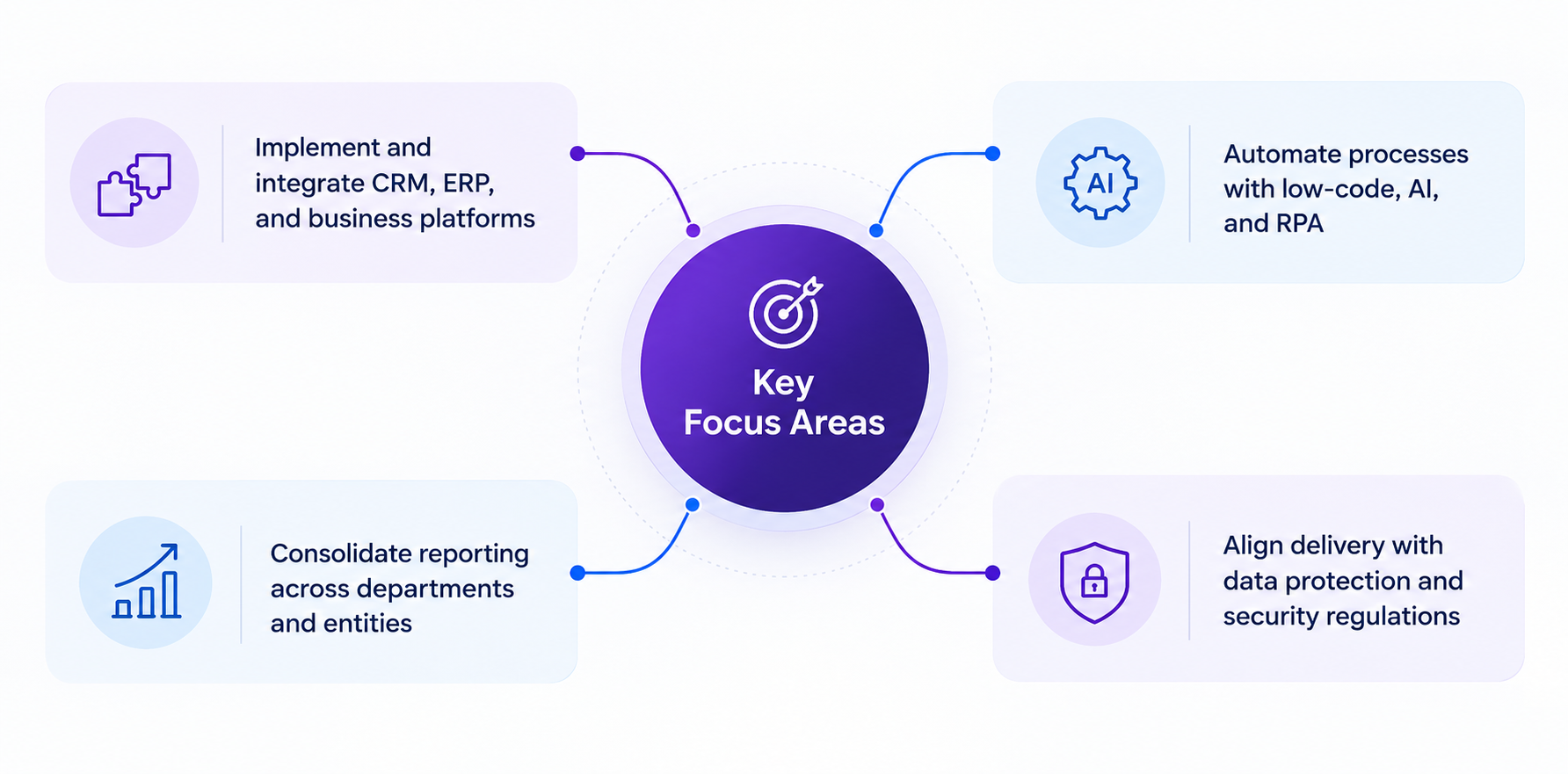
Right from assessment to managed services, we help enterprises connect systems, data, and people across Microsoft Dynamics 365, Power Platform, cloud, and AI.

Discuss Your Transformation Priorities

Digital Transformation Challenges We Solve

Transformation becomes difficult to plan when data, systems, people, and plans do not move in the same direction. We know how to tackle them.
Limited visibility
Management relies on manually drafted reports when important financial and operational information is scattered across multiple systems.
Disconnected systems
Business operations, finance, sales, and service running across multiple platforms make it hard to share data and maintain consistent workflows.
Low adoption
In the absence of properly aligned processes, training, and user roles, new platforms often fail to deliver their intended value.
Multi-entity complexity
Multiple legal entities, subsidiaries, reporting structures, and currencies make standards complex to apply throughout the enterprise.
AI without foundation
Several AI initiatives struggle to move beyond experimentation; underlying data is inconsistent, poorly governed, or fragmented.
Late compliance
Data protection and security requirements, if introduced late in a transformation process, can lead to delays, rework, and additional effort for execution.

Digital Transformation Implementation Framework

Each business challenge requires a different approach. At AKLogiks, we work in areas where connected processes, better data, and intelligent automation can add value to your business.

1.

Assessing and Aligning

We work with stakeholders to map their existing processes, identify areas for improvement, and develop clear objectives.

2.

Designing the roadmap

Once digital transformation objectives are defined, we work on target processes, data requirements, integrations, and solution architecture.

3.

Implementing in phases

We then deliver through controlled releases with defined acceptance criteria and milestones, reducing disruption to ongoing workflow.

4.

Enabling adoption

We prepare teams for change through role-based training supported by change management during the delivery.

5.

Supporting and Improving

The process operates through SLA-based support that covers security, stability, upgrades, and enhancements with evolving business requirements.

High-impact transformation areas

Digital transformation often starts with one function and extends over time. Explore common starting areas, how we handle them, and the associated business outcomes.
Common challenges
Transformation approach
Business outcomes

Finance

Disconnected processes across subsidiaries, limited management reporting, and slow consolidation.

Dynamics 365 Finance & Operations, with standardized financial processes, including multi-entity consolidation and budgeting.

Standardized controls

Entity-wide consolidation

Faster group reporting

Expansion capacity

Sales and service

Customer data is scattered across systems, with limited visibility into service performance and sales pipelines.

Dynamics 365 Sales and Customer Service, connected to Power BI, and integrated with ERP.

Cleaner pipeline visibility 

Service performance tracking

Single customer record

Measurable service levels

Supply Chain

Stock discrepancies, manual inventory management, and limited visibility across warehouses and stores. 

Dynamics 365 Retail and Advanced Warehouse Management, supported by operational dashboards.

Efficient warehousing 

Inventory accuracy 

Current stock data 

Better fulfillment control

Automation

Considerable staff time spent on email approvals, repetitive tasks, and duplicate data entry


Power Automate, Power Apps, RPA, and AI chatbots for approvals and routine requests.

Minimized manual effort

Increased staff capacity

Shorter turnaround

Digital Services

Multi-agency handoffs, paper-based approvals, and increasing demand for online services.

Mobile applications, portals, and eCommerce supported by automated processes and integrated with core systems.

Traceable approvals

Reduced processing time

Scalable platform

Web and mobile self-service

Cloud and IT

Rising support volumes, ageing infrastructure, and limited internal IT capacity.

DevOps automation, SLA-based support, Azure, and hybrid cloud migration.

Faster incident resolution 

Higher reliability 

Scalable infrastructure

Less IT workload

Data, analytics & AI

Inconsistent reporting, data silos, and AI initiatives that struggle to reach the production stage.

Azure Synapse, Microsoft Fabric with automated ETL, BI, and predictive models.

Self-service analytics 

AI-ready data

Single reporting source

Governed data 

Our Digital Transformation Capabilities

Clients can choose a single service or combine several across the digital transformation lifecycle. Each capability can work with your existing systems, teams, roadmap, and vendors.
Business Applications
Integration, implementation, and optimization of business applications, including Dynamics 365 Finance & Operations, CRM, and Business Central.
Power BI, Power Apps, Power Automate, AI-powered solutions, and SharePoint collaboration portals to extend business apps.
Mobile, web, eCommerce, and portal solutions built using Angular, Flutter, .NET, and React, integrated with ERP.
Data platforms on Azure Synapse and Microsoft Fabric, BI dashboards, analytics, NLP, RPA, and machine learning to improve efficiency.
Cloud strategy, hybrid environments, infrastructure automation, and security controls aligned with enterprise requirements and ISO 27001.
CI/CD pipelines, monitoring, service desk, infrastructure as code, and SLA-based support to stabilize systems after going live.

Let’s discuss your digital transformation roadmap

Our platform-based applications expertise

AKLogiks is an official partner of the leading technology providers listed below, and we are fully qualified to provide a full range of services and deliver powerful applications on top of these platforms.

Microsoft

We are a certified Microsoft partner. We integrate, implement, and support enterprise solutions on Dynamics 365, Power Platform, Microsoft Fabric, Microsoft 365, and Azure, consolidating finance, data, and teams on a unified, trusted ecosystem.
AKLogiks Success Stories

We measure our success by the success of our clients. See the tangible impact we have made.
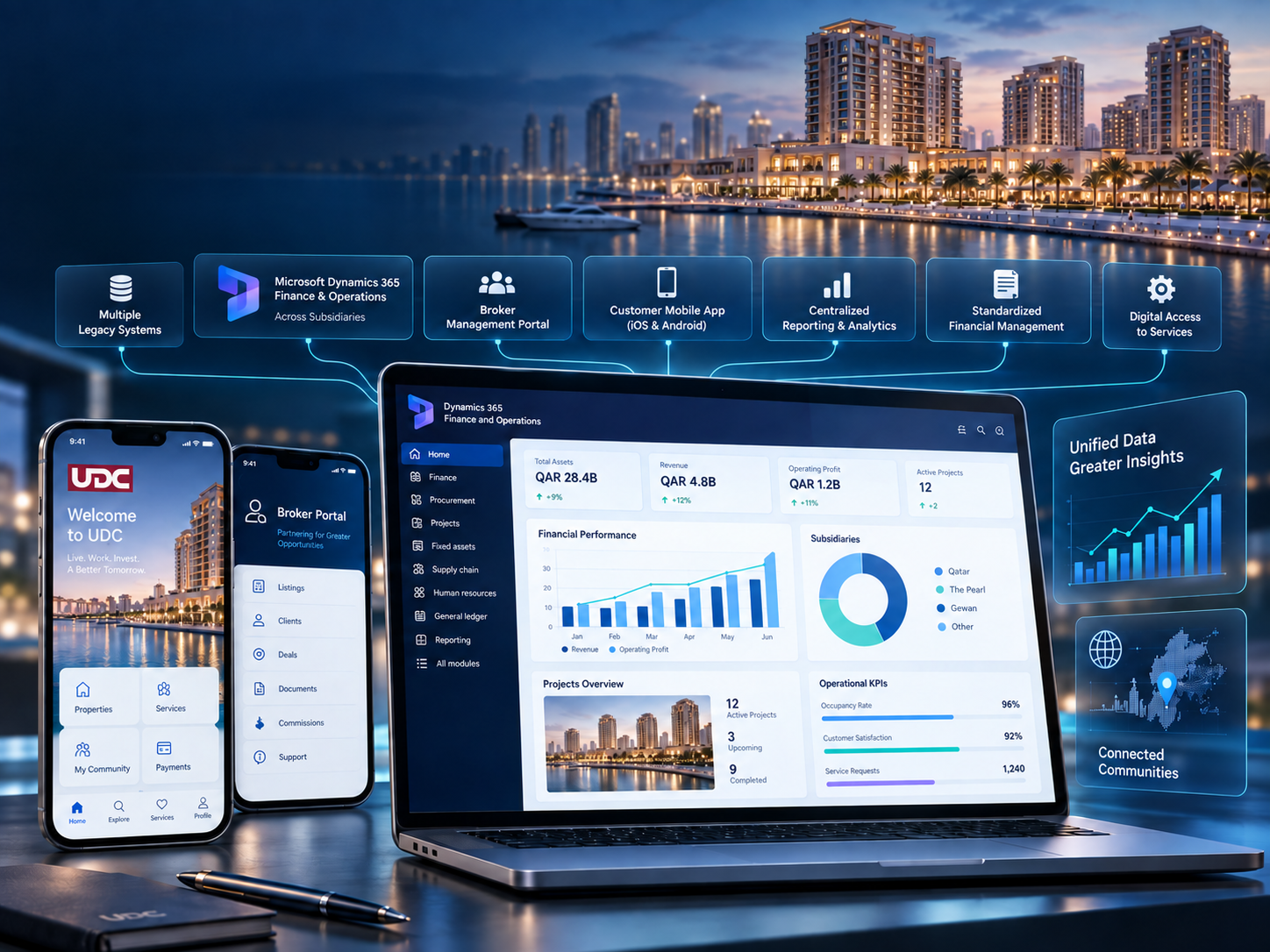
The operational workflow of the United Development Company ran on multiple systems without any unified data model, which kept processes manual and limited visibility for management. We implemented Microsoft Dynamics 365 Finance & Operations across all subsidiaries. AKLogiks also created a broker management portal on Dynamics CRM and Power Pages and developed the Pearl Owners mobile application for Android and iOS. Through this program, we centralized reporting, standardized financial management, and gave brokers and customers digital access to services.

Why Choose Us

AKLogiks brings business applications, strategy, cloud, AI, data, and managed services together under one delivery approach. Adoption, compliance, security, and post-launch support are built into the delivery mechanism. Flexible engagement models enable clients to choose the level of support that best fits their requirements.
30+

Years of Industry
Experience

20+

Global Active
Clients

6+

Countries with our Presence
and Clientele

100+

Employees Across
the Globe

30+

Years of Industry
Experience

Everything you may ask before booking a call

How long does it take to implement a complete digital transformation program?
The timeline depends on the extent, complexity, and number of systems involved. While corporate programs usually need a longer phased approach, focused initiatives like BI rollouts or process automation can be delivered in a few weeks. Enterprise-wide ERP programs usually take 12 months or more.
No. The first step is to evaluate current systems in relation to business and technological requirements. Depending on the transformation roadmap and business priorities, some systems can be upgraded or migrated, while others can be integrated.
Yes, certified trainers provide role-based training. Teams can adapt to new systems and procedures with the help of documentation, change management, and post-go-live support.
The extent and degree of support needed can be used to structure engagement. Project-based delivery, SLA-based managed services, and specialist resourcing to expand internal teams are among the available options. You can also combine these models.
Yes. We can operate within the current ITSM platforms, policies, tools, governance structures, and escalation protocols. When more technical capability or knowledge is needed, specialist resources can also be added.
Assessing current systems, procedures, data, and business priorities is the first step in the process. This creates the foundation for a workable transformation roadmap, and identifies development opportunities, and establishes the beginning point.
Every program takes security and compliance needs into account from the outset. Delivery is aligned with relevant laws and frameworks, including Saudi NCA ECC, SAMA requirements, and PDPL; UAE NESA and PDPL; Qatar’s Personal Data Privacy Protection Law; and ISO 27001 and ISO 27701.

Tell us What’s Getting in Your Way

Let’s discuss what you’re trying to solve, change, or improve.

    By sending this form I confirm that I have read and accept AKLogiks Privacy Policy.